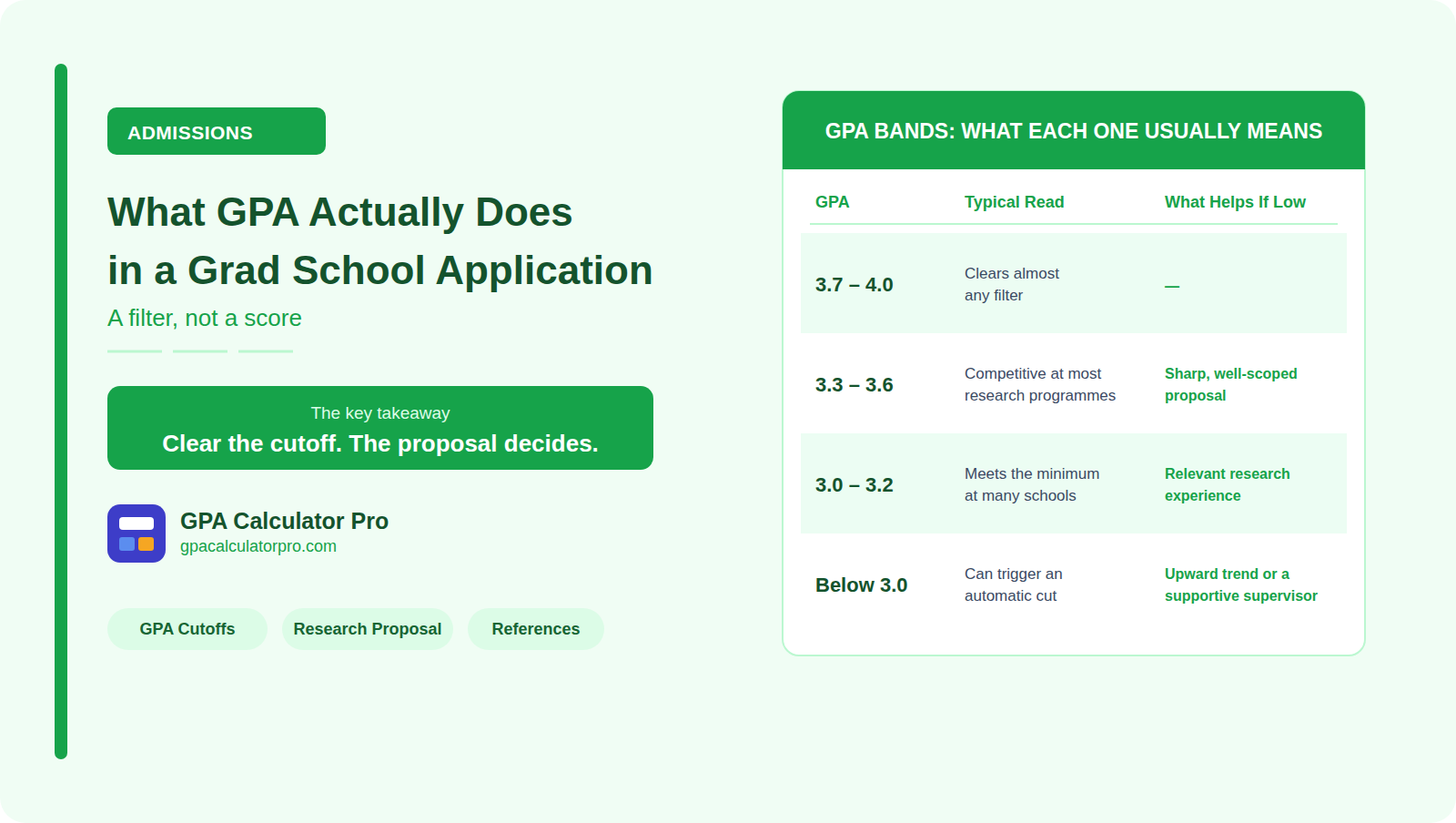
Is my GPA good enough? Wrong question. Admissions committees almost never read a GPA on its own. Here's what it actually does, and what carries more weight once it's done its job.
How Admissions Committees Read an Application
Most applications go through two rounds. The first is an eligibility check, often handled by administrative staff or an automated filter, where GPA, degree classification and basic requirements are confirmed. The second is a closer read by academics, usually the people who would supervise or teach the applicant. At that stage they are asking practical questions. Does this person understand the field? Is the proposed project realistic? Is there someone in the department who could supervise it? Grades answer only the first of those, which is why they carry less weight in round two than most applicants expect.
GPA Is a Filter, Not a Score
Most programmes use GPA to narrow the pile, not to rank it. Clear the minimum and your GPA mostly stops mattering. A 3.4 with a sharp, well-scoped research proposal beats a 3.8 with a vague one, in a field a department actually wants more research in.
GPA Bands: What Each One Usually Means
| GPA | Typical Read | What Helps If It's Low |
|---|---|---|
| 3.7 - 4.0 | Clears almost any filter. | — |
| 3.3 - 3.6 | Competitive at most research programmes. | A sharp, well-scoped proposal. |
| 3.0 - 3.2 | Meets the minimum at many schools. | Relevant research experience. |
| Below 3.0 | Can trigger an automatic cut. | An upward grade trend, or a supervisor willing to advocate for you. |
Worked Example: Does a Proposal Make Up the Gap?
3.8 GPA, generic proposal ("I want to study the effects of AI on society")
3.4 GPA, specific proposal (a named method, a named dataset, a clear gap in the literature)
Once both clear the GPA cutoff, B's application usually reads as stronger. Committees are evaluating whether the research is fundable and finishable, not just whether the applicant passed their courses.
What Makes a Research Proposal Strong
A strong proposal is specific. It states one clear research question rather than a broad theme, names the method it will use, and identifies the data source or sample. It points to a gap in the existing literature and explains why filling that gap matters. It also shows the project can be finished in the time and with the resources the programme provides. Finally, it connects to the research interests of the department, ideally of a named potential supervisor. A proposal that does these things tells the committee that the applicant can plan and complete research, which is the main thing they are trying to judge.
Other Parts of the Application That Carry Weight
Once the GPA has done its job, several other materials are read closely. References from academics who know your work well can carry real influence, especially when they speak to your research ability. Relevant experience, such as a research assistantship, a dissertation or a published paper, shows you can work independently. The personal statement should explain why this programme and this field, and it works best when it supports the proposal rather than repeating your CV. If your institution reports GPA on a different scale, check how the programme converts it so you present the number accurately.
It also helps to remember that committees read hundreds of files in a short window. Clear, direct writing is easier to assess than dense or ornate prose, and a well-organised proposal with sensible headings is easier to remember. Keep the focus on what you plan to do and why it can be done, and avoid padding the application with claims you cannot support with evidence.
A Practical Order of Work
Start by finding each programme's published minimum GPA and confirming you clear it. Shortlist programmes where faculty are actively working in your area, and read some of their recent papers. Draft the proposal early, ask a lecturer or supervisor to critique it, and revise it at least once. Request references well ahead of the deadline and give your referees a short summary of your plans. Leave time at the end to proofread everything together, so that the statement, proposal and references tell one consistent story.
Key Takeaway
Frequently Asked Questions
Is a 3.0 GPA good enough for a master's or PhD?
Can a strong proposal make up for a lower GPA?
Should I explain a low GPA in my personal statement?
Related Reading
Still deciding on a research area? Premier Dissertations keeps a list of current dissertation topics by subject.
Before you submit a proposal, run it through a plagiarism checker. Even original writing can flag if it leans too hard on standard phrasing from published abstracts.