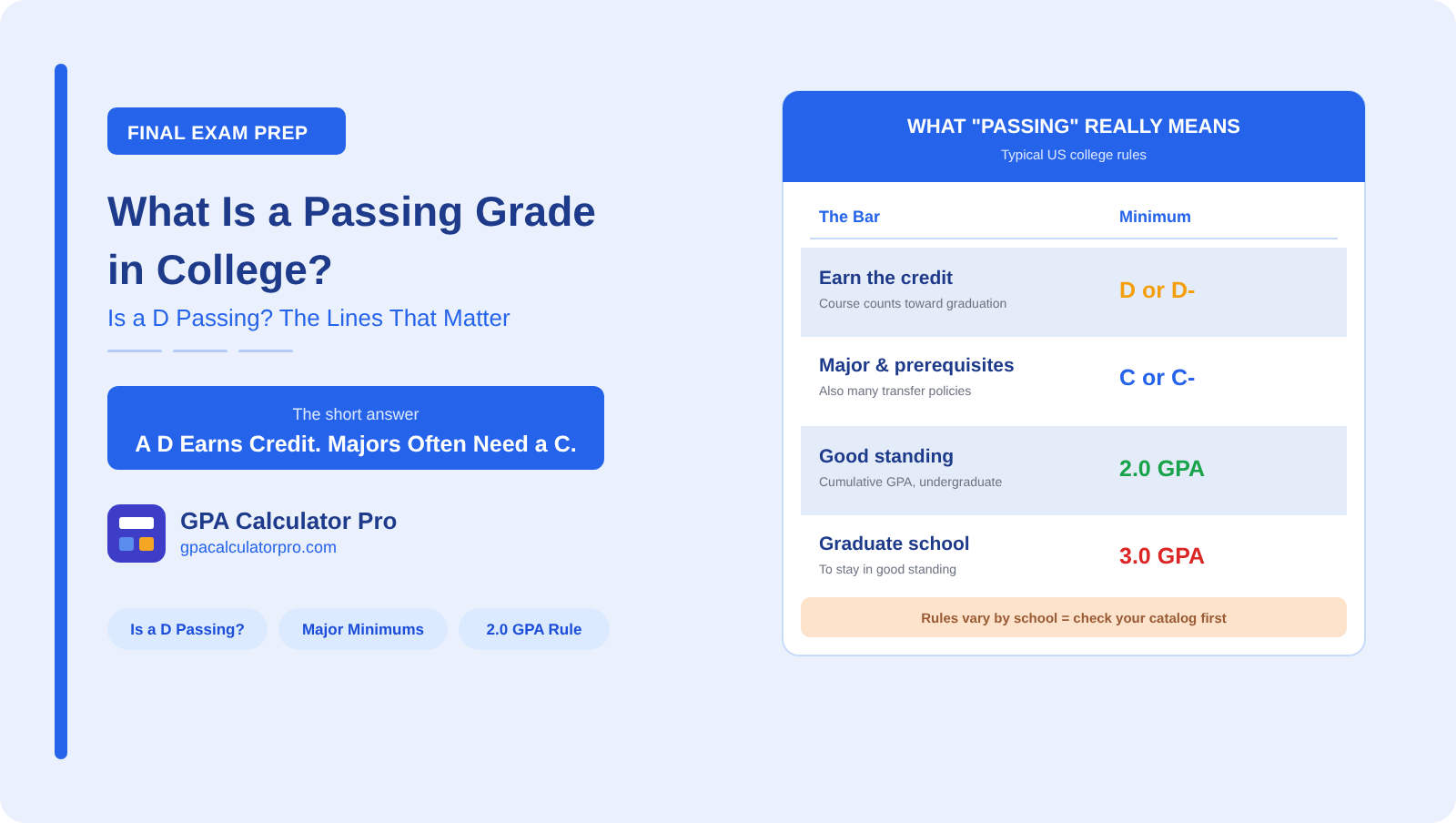
The short answer: at most US colleges, a D is the lowest passing grade. It earns you the credit for the course. But "passing" has three different meanings in college, and a D only clears the lowest one. Many majors, prerequisites and transfer policies require a C or C-, and to stay in good standing you need a 2.0 GPA, which is a C average.
This guide explains each of those lines with real university policies, shows exactly what a D does to your GPA, and tells you how to check the rule at your own school.
The Short Answer by School Level
Each school sets its own rules, but the pattern below holds at most US institutions:
| Level | Lowest grade that earns credit | The higher bar to watch |
|---|---|---|
| College | D or D- (around 60%) | C or C- for many majors, prerequisites and transfer credit; 2.0 GPA for good standing |
| High school | Set by the district: often 60%, sometimes 65% or 70% | Credit and graduation rules set by your district and state |
| Grad school | Often C- or higher (D grades may not exist) | A 3.0 GPA to stay in good standing |
The rest of this guide focuses on college, where the gap between "passing" and "good enough" catches the most students out.
Is a D Passing in College?
In most cases, yes. A D means you completed the course at a level the college accepts for credit, but only just. Florida Atlantic University's registrar, for example, lists D+, D and D- as grades that are "considered passing for undergraduate students" while noting that they "indicate weak performance". UC Santa Cruz likewise awards credit toward graduation for grades of D- or higher.
So a D usually means:
- You earn the credits. They count toward the total you need to graduate.
- You do not have to retake the course unless a specific requirement needs a higher grade.
- Your GPA takes a hit. A D is worth just 1.0 grade point on the 4.0 scale (a D- is 0.7).
When a C Is the Real Minimum
Three situations commonly raise the bar from a D to a C:
1. Courses in your major
Many departments only count major courses passed with a C or better. UC Santa Cruz puts it plainly: a C (2.0) or higher is required to fulfill general education or major requirements, and grades of C- or lower do not count for them. Florida Atlantic notes that some programs require a C- or better for major courses even though a D passes.
2. Prerequisites
If Calculus I is a prerequisite for Calculus II, the department may require a C in Calculus I before you can enroll in the next course. A D gives you the credit but can still block your path to the next class. UC Santa Cruz applies its C-or-better rule to prerequisites as well.
3. Transfer credit
Colleges often refuse to accept D grades from other schools. Colorado State University's policy says courses completed with a C- or better are generally accepted in transfer, and notes that programs requiring a C may not accept a C-. If you are taking classes at a community college to transfer later, aim for at least a C.
What Counts as a Passing GPA?
Individual grades are only half of the picture. Colleges also judge your overall record, and the line almost everywhere is a 2.0 cumulative GPA:
- Good standing: NC State, for example, requires a cumulative GPA of at least 2.0. Below that, students move to academic warning and then probation.
- Graduation: a 2.0 is also the most common minimum to graduate. UC Santa Cruz states that you must have a minimum 2.0 GPA to graduate.
- Graduate school: the bar is higher. The University of Missouri Graduate School treats C-range grades as passing but requires a cumulative 3.0 to remain in good standing.
Because a C is worth exactly 2.0 points, a run of D grades puts you below the good-standing line even though every one of those courses "passed". Not sure where you stand? Check your overall number with the Cumulative GPA Calculator.
What a D Does to Your GPA - Worked Example
Take a student carrying 15 credits this semester: B grades in English, Psychology and Statistics, a C in History (all 3 credits each), and a 3-credit Biology course that could go several ways. They already have 45 credits at a 3.00 GPA. Here is how the Biology grade changes the picture:
| Biology grade | Credits earned | Term GPA | Overall GPA* |
|---|---|---|---|
| A | 15 | 3.00 | 3.00 |
| C | 15 | 2.60 | 2.90 |
| D | 15 | 2.40 | 2.85 |
| F | 12 | 2.20 | 2.80 |
Credits earned are out of 15 attempted. *Overall GPA is the cumulative GPA after combining this semester with 45 earlier credits at 3.00. Calculated with the same credit-weighted formula as our College GPA Calculator (A = 4, B = 3, C = 2, D = 1, F = 0).
Three things stand out:
- A D keeps the credits an F would lose. The D student finishes with all 15 credits; the F student earns 12.
- A D still costs real GPA. Dropping from a C to a D takes 0.20 off this semester's GPA.
- One grade moves your cumulative GPA slowly. The same D only takes the cumulative GPA from 2.90 to 2.85, because 45 earlier credits soften the blow.
If Biology is a major course that needs a C, this student would have to retake it. Whether the retake helps their GPA depends on the school's policy. If the new C replaces the D, the semester GPA in this example recovers to 2.60. If both grades stay in the calculation, it only reaches 2.33. The College GPA Calculator has a retake option that shows both versions.
Is 70 a Passing Grade?
It depends on the scale your school uses:
- In most college courses, yes. On the standard plus/minus scale used in our 4.0 scale guide and Grade Calculator, 70% is a C-, which passes and earns credit. Scores below 60% are an F.
- In some high schools, 70 is the cut-off itself. Houston ISD, for example, says course credit is earned through a passing grade of 70% or above. In a district like that, a 69% fails the course.
- Other districts set the line lower. Fairfax County Public Schools' scale starts its D range at 60%.
Remember that a C- is often not enough for courses that require a full C, so 70% can pass the course without satisfying a major requirement.
How to Check Your School's Rule
Do not rely on a general rule when a requirement is at stake. Check these, in order:
- The course syllabus: it states the grading scale and any minimum grade for the course.
- The academic catalog: search it for "minimum grade", "grade of C or better" and "academic standing".
- Your degree audit: it shows which courses count toward your major and flags grades that do not.
- Your academic advisor: ask directly whether a D will count, before you choose to accept it.
Close to Failing? Work Out What You Need on the Final
If you are near the line, the most useful thing you can do is find out exactly what the final exam has to deliver. Suppose you have 58% going into a final worth 30% of the course:
| Target grade | Final score needed (58% now, final worth 30%) | Realistic? |
|---|---|---|
| D (60%) | 64.7% | Yes |
| C- (70%) | 98.0% | Only with a near-perfect final |
| C (73%) | 108.0% | No - out of reach |
These figures use the same formula as our Final Grade Calculator. In this example, passing with a D is well within reach, but a C- needs a near-perfect final, and a C is no longer possible. If your course needs a C, that tells you it is time to talk to your professor or advisor about your options. If the result is above 100%, read what to do when your required final score is above 100%.
If a pass is already secure but your GPA has taken a hit, how to raise your GPA fast covers grade replacement, pass/fail and withdrawal deadlines.